





Edición en inglés
Jugadores: 1-5
Duración: 120-900 min
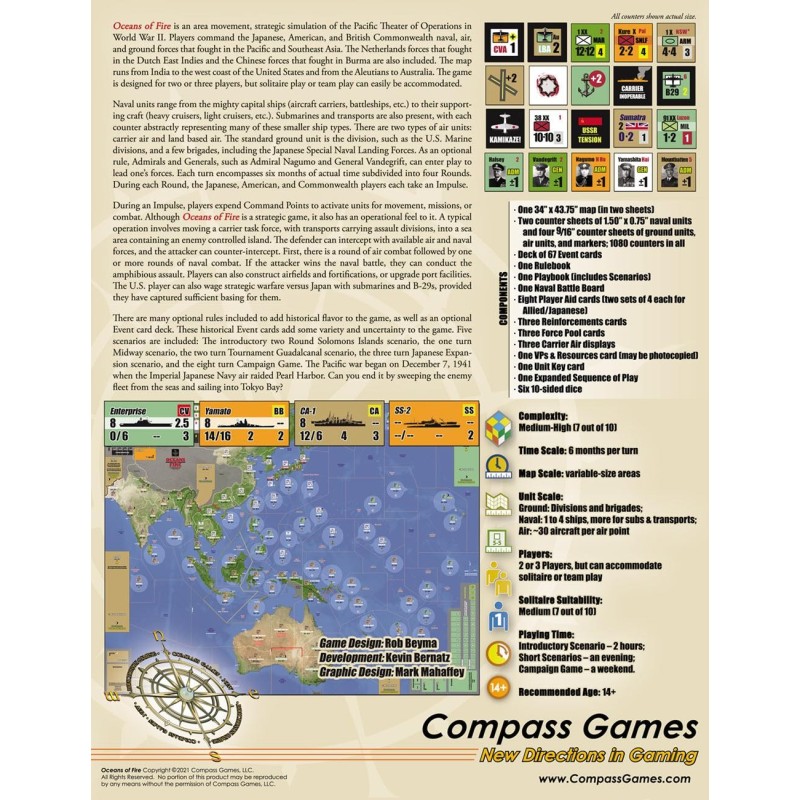
Oceans of Fire is an area movement, strategic simulation of the Pacific Theater of Operations in World War II with an operational feel. Players command the Japanese, American, and British Commonwealth naval, air, and ground forces that fought in the Pacific and Southeast Asia. The Netherlands forces that fought in the Dutch East Indies and the Chinese forces that fought in Burma are also included. The map runs from India to the west coast of the United States and from the Aleutians to Australia. The game may be played with either two or three players. In the three-player game, a second Allied player commands the Commonwealth, Dutch, and Chinese forces.
There are five scenarios:
Introductory Solomons Islands scenario
One-turn Midway scenario
Two-turn Tournament Guadalcanal scenario
Three-turn Japanese Expansion scenario
Eight-turn Campaign Game
Naval units have one or two carriers or battleships per counter, and two to four cruisers per counter. Additionally, there are submarine and transport counters representing many ships. There are two types of air units: carrier air and land-based air, with approximately 30 aircraft per air point. The standard ground unit is the division with a few brigades including the Japanese Special Naval Landing Forces. There are also some Admirals and Generals such as Admiral Nagumo and General Vandegrift. Each turn encompasses six months of actual time subdivided into four Rounds (a special first turn covers only four months). During each Round, the Japanese, American, and Commonwealth players each take an Impulse. The order of movement is based on which player has the most Command Points (CPs) that turn. The number of CPs available to the Japanese player after the first turn depends on the number of Oilfields and Resources that he controls. This number can be reduced by U.S. submarines and B-29s using Strategic Warfare. The U.S. and Commonwealth CPs increase as the war progresses although the Commonwealth total can be reduced by lost territory in Australia and India.
Players expend Command Points to activate units for movement, missions, or combat. Although Oceans of Fire is a strategic game, it also has an operational feel to it. A typical operation involves moving a carrier task force, with transports carrying assault divisions, into a Sea Area containing an enemy controlled island. The defender can intercept with available air and naval forces, and the attacker can counter intercept. First, there is a round of air combat followed by one or more rounds of naval combat. The naval combat rounds can be carrier or surface, weighted in favor of carrier action. Air units attack individual ship counters with carrier air being more deadly. If the attacker wins the naval battle, he can conduct the amphibious assault. Players can also construct airfields and fortifications, or upgrade port facilities. The game also has the American Fleet Supply Train, Japanese kamikazes, and monsoon weather. A deck of historical Event cards adds a lot of variety and some uncertainty to the game with cards such as the Doolittle Raid, Tokyo Express, Chindits, and ‘MAGIC’.
Components:
Combined 34 x 43 inch game map (two unmounted map sheets)
Two counter sheets of 1.5” x .75” naval units and four 9/16” counter sheets of ground units, air units, and markers; 1080
counters in all
Deck of 67 Event cards
One Rulebook
One Scenario Book
One Naval Battle Board
Four Player Aid cards
Three Reinforcements cards
Three Force Pool cards
Three Carrier air displays
Four 10-sided dice
Box and Lid
https://dracotienda.com/wargames/34586-oceans-of-fire.html
34586
Oceans of Fire
<p></p><p style="text-align:justify;"><strong>Edición en inglés</strong></p>
<p style="text-align:justify;">Jugadores: 1-5<br /> Duración: 120-900 min</p>
<p>Oceans of Fire is an area movement, strategic simulation of the Pacific Theater of Operations in World War II with an operational feel. Players command the Japanese, American, and British Commonwealth naval, air, and ground forces that fought in the Pacific and Southeast Asia. The Netherlands forces that fought in the Dutch East Indies and the Chinese forces that fought in Burma are also included. The map runs from India to the west coast of the United States and from the Aleutians to Australia. The game may be played with either two or three players. In the three-player game, a second Allied player commands the Commonwealth, Dutch, and Chinese forces.</p>
<p>There are five scenarios:<br /> Introductory Solomons Islands scenario<br /> One-turn Midway scenario<br /> Two-turn Tournament Guadalcanal scenario<br /> Three-turn Japanese Expansion scenario<br /> Eight-turn Campaign Game</p>
<p>Naval units have one or two carriers or battleships per counter, and two to four cruisers per counter. Additionally, there are submarine and transport counters representing many ships. There are two types of air units: carrier air and land-based air, with approximately 30 aircraft per air point. The standard ground unit is the division with a few brigades including the Japanese Special Naval Landing Forces. There are also some Admirals and Generals such as Admiral Nagumo and General Vandegrift. Each turn encompasses six months of actual time subdivided into four Rounds (a special first turn covers only four months). During each Round, the Japanese, American, and Commonwealth players each take an Impulse. The order of movement is based on which player has the most Command Points (CPs) that turn. The number of CPs available to the Japanese player after the first turn depends on the number of Oilfields and Resources that he controls. This number can be reduced by U.S. submarines and B-29s using Strategic Warfare. The U.S. and Commonwealth CPs increase as the war progresses although the Commonwealth total can be reduced by lost territory in Australia and India.</p>
<p>Players expend Command Points to activate units for movement, missions, or combat. Although Oceans of Fire is a strategic game, it also has an operational feel to it. A typical operation involves moving a carrier task force, with transports carrying assault divisions, into a Sea Area containing an enemy controlled island. The defender can intercept with available air and naval forces, and the attacker can counter intercept. First, there is a round of air combat followed by one or more rounds of naval combat. The naval combat rounds can be carrier or surface, weighted in favor of carrier action. Air units attack individual ship counters with carrier air being more deadly. If the attacker wins the naval battle, he can conduct the amphibious assault. Players can also construct airfields and fortifications, or upgrade port facilities. The game also has the American Fleet Supply Train, Japanese kamikazes, and monsoon weather. A deck of historical Event cards adds a lot of variety and some uncertainty to the game with cards such as the Doolittle Raid, Tokyo Express, Chindits, and ‘MAGIC’.</p>
<p>Components:<br /> Combined 34 x 43 inch game map (two unmounted map sheets)<br /> Two counter sheets of 1.5” x .75” naval units and four 9/16” counter sheets of ground units, air units, and markers; 1080<br /> counters in all<br /> Deck of 67 Event cards<br /> One Rulebook<br /> One Scenario Book<br /> One Naval Battle Board<br /> Four Player Aid cards<br /> Three Reinforcements cards<br /> Three Force Pool cards<br /> Three Carrier air displays<br /> Four 10-sided dice<br /> Box and Lid</p>
http://dracotienda.com/176156-home_default/oceans-of-fire.jpg
98.1004
instock
Compass Games
109.0004
81.0747
9.999963302887
10.9
1693327868000
/Inicio
/Inicio/Wargames